News
-
![]()
![]()
SFB 1245 publication highlighted as Editor's Suggestion
2025/12/04
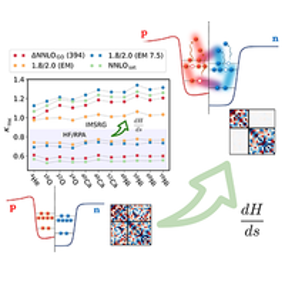
The publication “Impact of ground-state correlations on the multipole response of nuclei: Ab initio calculations of moment operators” (Phys. Rev. C 112, 054303) was highlighted as Editor's Suggestion.
-
![]()
![]()
Charge radii and theory of exotic tin isotopes published in PRL
2025/11/26
New SFB 1245 Publication in Physical Review Letters
-
![]() Picture: KI-generiert mit MS Copilot
Picture: KI-generiert mit MS Copilot![]() Picture: KI-generiert mit MS Copilot
Picture: KI-generiert mit MS CopilotDetecting fingerprints of almond-shaped Nuclei
2025/11/12
TU Researchers publish study on triaxial structures
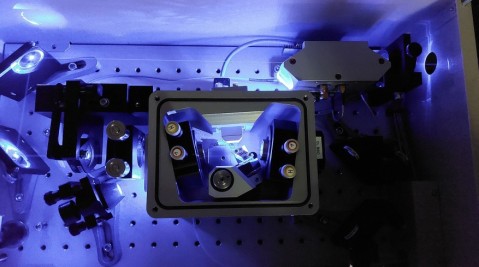
Laser Spectroscopy can be used to determine the relative size of different atomic nuclei of the same element by measuring tiny changes in their atomic spectra. We set up a novel apparatus for such experiments at Argonne National Laboratory and were able to reach outstanding sensitivity. These new developments allowed us to investigate the size of a series of radioactive ruthenium nuclei, which are known to be triaxial in shape: Similar to a coffee bean or an almond, all three axes have a different proportion.
-
![]()
![]()
Giersch Awards for members of SFB 1245
2025/11/10
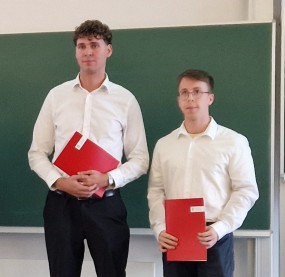
Jörn Kleemann (B02) received a “Giersch Award 2025 for an Outstanding Doctoral Thesis” and Julian Palmes (A03) won a “Giersch-Excellence Award 2025”. Congratulations to our award winners!
-
![]()
![]()
Awards for Master Theses
2025/10/24
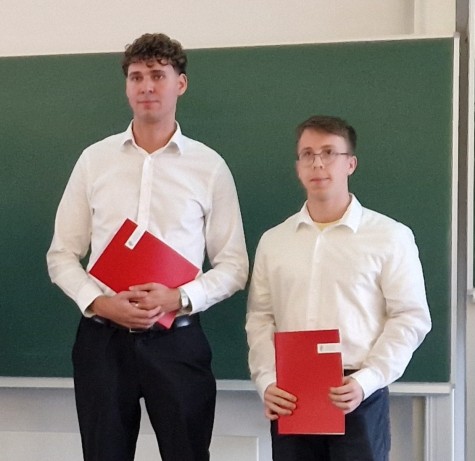
Julien Spahn (A01) and Tom Plies (A04) each received a Master's Research Award from the Gerhard Herzberg Society for their outstanding master's theses. The SFB congratulates them and all other award winners on their achievements.
-
![]()
![]()
Visit of Prof. Thomas Papenbrock as Humboldt Return Fellow
2025/10/20
The SFB1245 welcomes Prof. Thomas Papenbrock who works with us for 3 months as a Humboldt Return Fellow
-
![]()
![]()
Topical Lecture Week 2025 with Prof. Evgeny Epelbaum (Ruhr-Universität Bochum)
2025/08/20
Prof. Evgeny Epelbaum was the lecturer of our Theoretical Topical Lecture Week in Summer 2025 and presented 6 Lectures on “Effective theory of nuclear interactions” to the young Researchers of the SFB.
-
Andreas Geißel defended his dissertation successfully
2025/07/14
Andreas Geißel (SFB 1245, B05) defended his dissertation entitled „Phase structure and Thermodynamics of cold and dense quark matter“ successfully. Congratulations.
-
![]() Picture: Patrick Müller
Picture: Patrick Müller![]() Picture: Patrick Müller
Picture: Patrick MüllerHow large is a carbon nucleus?
2025/07/09
TU researchers set a new benchmark
-
![]()
![]()
The ‘strange’ side of atomic nuclei
2025/06/17
Professor Alexandre Obertelli receives ERC Advanced Grant worth €2.9 million
Unlike normal atomic nuclei, little is known about so-called hypernuclei, which belong to the category of ‘strange matter’. Prof. Alexandre Obertelli from the Institute for Nuclear Physics of TU Darmstadt wants to change that. His project, ‘When antimatter meets strangeness: a new era for precision hypernuclear physics’ (HYPER), is now being funded by the European Research Council (ERC) for five years with an Advanced Grant totalling €2.9 million.
-
![]()
![]()
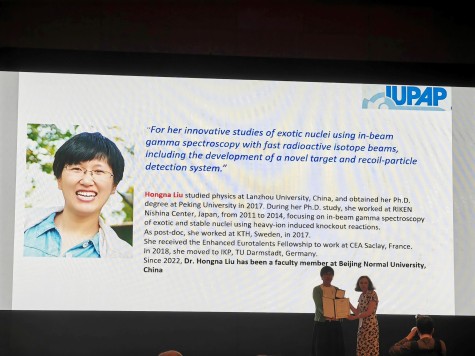
Hongna Liu awarded with IUPAP Early Career Scientist Prize
2025/06/16
-
![]()
![]()
Giacomo Ricigliano defended his dissertation successfully
2025/06/06
Giacomo Ricigliano (SFB 1245, B07) defended his dissertation entitled „Probing the origin of heavy elements in extreme conditions: the message of kilonovae“ successfully. Congratulations.
-
![]()
![]()
Topical Lecture Week 2025 with Prof. Iain Moore (Jyväskylä, Finland)
2025/05/15
Prof. Iain Moore was the lecturer of our Experimental Topical Lecture Week in Spring 2025 and presented 6 Lectures on “Nuclear Ground-State Properties” to the young Researchers of the SFB.
-
Tim Stetz defended his dissertation successfully
2025/02/10
Tim Stetz (SFB 1245, B02) defended his dissertation entitled „Evolution of isovector-quadrupole valence-shell excitations of heavy vibrational nuclei“ successfully. Congratulations.